Overview
Six Bruker BEST experiments cover a complete backbone assignment (HN, N, Cα, Cβ, CO) for a 13C/15N-labeled protein. BEST pulses excite only amide protons. Aliphatic protons and water stay untouched and speed up HN relaxation, so the recycle delay can be very short (0.2–0.4 s).
| Experiment | Pulse program | Peaks at (H, N) of residue i | 13C carrier (O2P) | Role |
|---|---|---|---|---|
| BEST-HSQC | b_hsqcetf3gpsi | (H, N) only | not used | Reference 2D, sample check |
| HNCO | b_hncogp3d.2 | CO(i-1) | CO, ~176 ppm | Most sensitive 3D; CO link |
| HN(CA)CO | b_hncacogp3d.2 | CO(i), CO(i-1) | CO, ~176 ppm | Partner of HNCO |
| HNCACB | b_hncacbgp3d.2 | Cα, Cβ of i and i-1 | aliphatic, ~40 ppm | Main backbone experiment; residue type |
| HN(CO)CACB | b_hncocacbgp3d.2 | Cα(i-1), Cβ(i-1) | aliphatic, ~40 ppm | Partner of HNCACB; identifies i-1 |
| intra-HNCACB | b_hncacbigp3d | Cα(i), Cβ(i) only | aliphatic, ~40 ppm | Optional; removes i/i-1 ambiguity |
Recommended run order:
- BEST-HSQC (2D check of sample and HN range)
- HNCACB
- HN(CO)CACB
- HNCO
- HN(CA)CO
- intra-HNCACB (only if time allows or i/i-1 is ambiguous)
For a well-dispersed folded protein (for example a ubiquitin fold, up to ~150 residues), steps 1–5 are normally enough. 4D experiments are only worth the effort for helical, large, or disordered proteins with heavy overlap.
The simultaneous 13C/15N NOESY-HSQC (for NOE distance restraints) has its own section below. It is not a BEST experiment and uses different settings, especially a longer d1.
Common settings
Use the same values in all six experiments so the spectra overlay directly. The 13C carrier is the only setting that changes between experiments (see the next section).
| Parameter | Value (600 MHz) | Notes |
|---|---|---|
| ZGOPTNS | -DCALC_SP | Calculates all band-selective 1H pulses from cnst54 and cnst55. Required in every experiment. |
| cnst54 | 8.3 ppm | Center of the HN band |
| cnst55 | 4.2–5.0 ppm | Width of the HN band. Excited range is cnst54 ± cnst55/2. Keep the upfield edge at or above ~5.8 ppm so Hα and water are not touched. |
| cnst21 | ~176 ppm | CO offset |
| cnst22 | ~53–56 ppm | Cα offset (HNCO, HN(CA)CO, HN(CO)CACB). 53.2 ppm is fine. |
| O1P | 4.7 ppm | Water |
| O3P | 116–118 ppm | Match your 15N HSQC |
| d1 | 0.2–0.4 s | The main time saving of BEST. Do not use 1 s. |
| ns | 8 (multiple of 8) | ds ≥ 16. HSQC allows ns = 1 × n. |
| F3 SW | ~12 ppm | Covers about −1.3 to 10.7 ppm with O1P at 4.7 ppm |
| F3 TD | ~680 | Gives aq ≈ 47 ms |
| aq | ≤ 50 ms | 15N decoupling runs during acquisition and d1 is short, so long aq heats the sample and probe. |
The relation aq = TD / (2 × SW in Hz) controls acquisition time. To shorten aq, lower TD or increase SW. Reducing SW makes aq longer.
After changing cnst54, cnst55 or any carrier, open ased or start zg once so -DCALC_SP recalculates p41, p42, p43 and their powers. At 600 MHz they should be close to 2.2, 1.4 and 1.7 ms.
NS rule
- ns must be a whole multiple of the phase cycle. Otherwise artifacts and axial peaks are not cancelled.
- All five 3D experiments (HNCO, HN(CA)CO, HNCACB, HN(CO)CACB, intra-HNCACB): ns = 8 × n (8, 16, 24 …).
- BEST-HSQC: ns = 1 × n (any value).
- ds ≥ 16 in all experiments.
- S/N grows with √ns. Doubling S/N needs 4 × ns and 4 × the time.
- The same rule applies with NUS. NUS removes increments, not scans.
Per-experiment settings
The 13C carrier (O2P) is the most common setup error. CO experiments use ~176 ppm and Cα/Cβ experiments use ~40 ppm. Always check O2P when copying parameters from another experiment.
| Experiment | O2P | ZGOPTNS | Extra constants | Check before running |
|---|---|---|---|---|
| BEST-HSQC | not used | -DCALC_SP -DLABEL_CN | cnst4 = J(NH), ~92 Hz | -DLABEL_CN adds a 13C 180° pulse in t1. Use it for 13C/15N-labeled samples, omit it for 15N-only samples. |
| HNCO | ~176 ppm (CO) | -DCALC_SP | cnst22 ~53–56 ppm | O2P must be on CO, not aliphatic. |
| HN(CA)CO | ~176 ppm (CO) | -DCALC_SP | cnst22 ~53–56 ppm | p24 and sp9 (selective Cα 180°) must be non-zero with a shape assigned. Weakest experiment. |
| HNCACB | ~40 ppm (aliphatic) | -DCALC_SP | cnst21 ~176 ppm | Never add -DLABEL_CB. |
| HN(CO)CACB | ~40 ppm (aliphatic) | -DCALC_SP | cnst21 ~176, cnst22 ~53–56 ppm | Never add -DLABEL_CB. |
| intra-HNCACB | ~40 ppm (aliphatic) | -DCALC_SP | cnst21 ~176 ppm | Never add -DLABEL_CB. 15N is full constant time, so td2 has a maximum. |
Flag notes
- -DLABEL_CB (HNCACB, HN(CO)CACB, intra-HNCACB) doubles d28 from 3.6 to 7.2 ms. Cα is then suppressed and only Cβ remains (plus Gly Cα). This is wrong for normal backbone assignment.
- -DLABEL_CN only exists in BEST-HSQC. In the 3D experiments it has no effect, so leaving it in ZGOPTNS is harmless.
- -DTRIMP does not exist in any of these six. It belongs to other sequences such as noesyhsqcgpsismsp3d.
- Fixed delays (d22, d23, d25, d26, d28) are written into each pulse program. Do not change them.
Expected peak signs
- HNCACB, HN(CO)CACB, intra-HNCACB: Cα and Cβ have opposite signs. Phase Cα positive. BEST-HN(CO)CACB differs from the classic CBCA(CO)NH, where Cα and Cβ usually have the same sign.
- HN(CA)CO: CO(i) and CO(i-1) have the same sign. CO(i) is usually stronger.
After changing O2P or loading a parameter set, run getprosol, then check in ased that no shaped pulse length (p13, p14, p24, p41–p44) is 0.
Indirect dimensions and NUS
In all five 3D experiments F1 is 13C (States-TPPI) and F2 is 15N (Echo-Antiecho). Keep O3P, 15N SW and td2 identical across experiments, and keep the 13C SW and td1 identical within each carrier group, so strips overlay.
| Dimension | SW (600 MHz) | Conventional TD | TD with 20–25% NUS | Limit |
|---|---|---|---|---|
| 13C aliphatic (HNCACB group) | 70–75 ppm | 64–80 | ~160 (t1max ~7 ms) | Cα–Cβ coupling (~35 Hz) makes t1max beyond ~7–8 ms of little use |
| 13CO (HNCO group) | ~12 ppm (170–182 ppm) | 64 | 96–128 (t1max 26–35 ms) | Cα is decoupled, so CO can be sampled long |
| 15N (HNCO, HN(CA)CO, HNCACB, HN(CO)CACB) | 30–40 ppm | 32–40 | 80–96 | Semi-constant time; in29/in30 are calculated automatically |
| 15N (intra-HNCACB) | 30–40 ppm | 32–40 | ≤ 108–144 | Full constant time. td2 max = 2 × d30 / in30 (~108 at 30 ppm, ~144 at 40 ppm). TopSpin reduces td2 automatically. |
NUS guidance
- Experiment time scales almost linearly with the NUS fraction.
- Use NUS to buy resolution, not only time. With the same ~2 h per experiment, a 20% NUS grid can be about twice as long in both indirect dimensions as a conventional grid.
- 20% NUS with ns = 8 is fine for HNCO, HNCACB and HN(CO)CACB.
- For the weak experiments (HN(CA)CO, intra-HNCACB), check the test plane first. If weak peaks are close to noise, use 30% NUS or ns = 16.
- Very small grids (for example td1 80 × td2 40) reconstruct less reliably. For those, use 50% NUS or full sampling.
- In TopSpin set FnTYPE = non-uniform_sampling and NusAMOUNT, then generate the NUS list. TD still describes the full grid.
Check the total time with expt before starting.
Quick tests before the full 3D
Each test takes a few minutes and catches most setup errors. Fix rg after the first rga and keep rg, ns and ds identical when comparing settings.
- 1D (td1 = td2 = 1). Confirm HN signals across the expected range and low residual water. If peaks stop at a fixed ppm, check F3 SW/O1P and the cnst54/cnst55 band.
- 1H–15N plane (td1 = 1, td2 ≈ 64). Looks like a BEST-HSQC. Confirms the 15N carrier and SW.
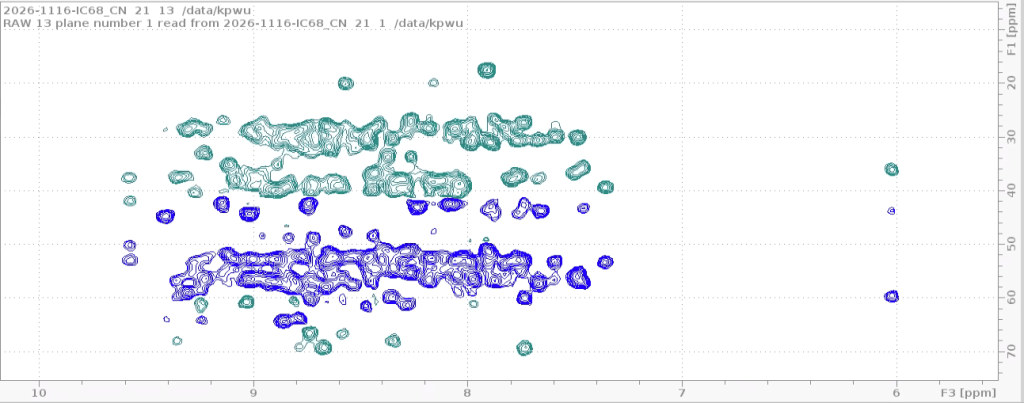
- 1H–13C plane (td2 = 2, td1 ≈ 64). Confirms 13C carrier and SW and the peak pattern. For the HNCACB group, Cα and Cβ must both appear with opposite signs. For HN(CA)CO, two CO peaks per HN should appear.
Use td2 = 2 rather than 1 for the 13C plane. F2 is Echo-Antiecho, and td2 = 2 records both echo and antiecho. Process it as 3D and read out the F1–F3 plane.
A td2 = 1 plane can be read with rser2d and processed with xfb. It is pure phase at t2 = 0 but uses only half the scans.
Troubleshooting
| Symptom | Likely cause | Fix |
|---|---|---|
| No or very weak signal in HNCO / HN(CA)CO | O2P left at ~40 ppm from an aliphatic experiment | Set O2P = cnst21 ≈ 176 ppm, rerun getprosol |
| No or very weak signal in HNCACB group | O2P left at ~176 ppm from a CO experiment | Set O2P ≈ 40 ppm |
| Only Cβ peaks (plus Gly Cα) | -DLABEL_CB in ZGOPTNS | Remove -DLABEL_CB |
| HN(CA)CO shows one peak per HN, matching HNCO | Cα→CO transfer failing | Check p24 and sp9 are set and non-zero |
| Peaks missing at the edge of the HN range | HN band too narrow, or F3 SW too small | Widen cnst55 or shift cnst54; check F3 SW and O1P |
| A flag change makes no difference | Flag misspelled (no leading dash) or the related pulse length is 0 | Write -DNAME exactly; check the pulse length in ased |
| zg error on in29 or td2 | SW combination gives a negative delay, or td2 above the constant-time limit | Check in29 ≥ 0; reduce td2 or 15N SW |
| Weak fast-exchanging amides | High pH or temperature | Check sample conditions; BEST itself does not saturate water |
| Sample or probe heating | aq too long with short d1 |

