Information
Robust and Interpretable Machine Learning for Affinity and Functional Prioritization of Designed Protein Interactors.
Protein Science 2026 Jun;35(6):e70617
Protein–protein interactions govern nearly every biological process, from signal transduction and protein degradation to immune regulation and enzyme control. Yet designing proteins that bind selectively and tightly to a desired target remains one of the central challenges in modern protein engineering. While recent AI-driven structure prediction and protein design tools have dramatically accelerated the generation of candidate binders, identifying which designs are most likely to work experimentally remains a major bottleneck.
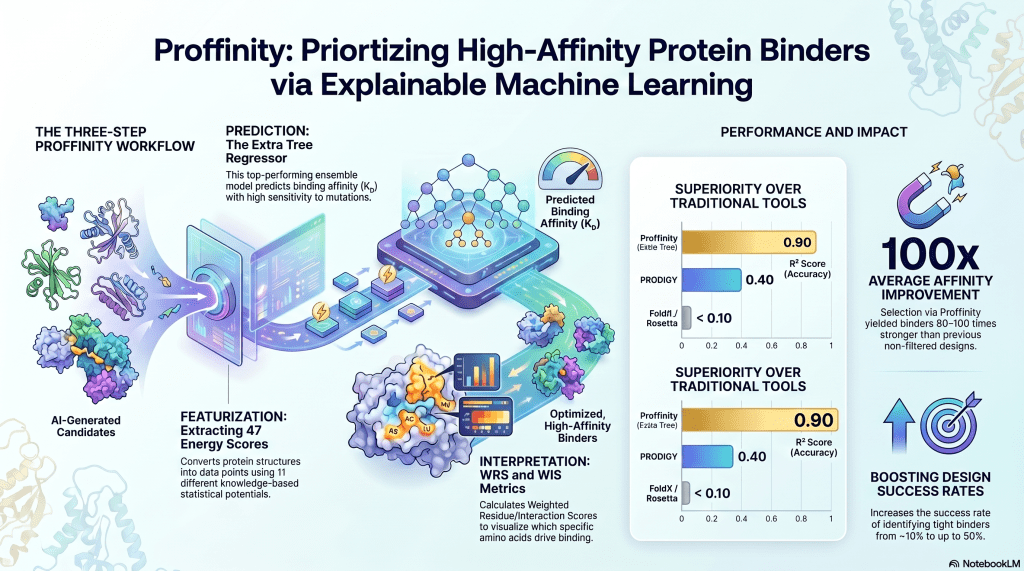
In our new work published in Protein Science, we present Proffinity, an explainable machine learning framework designed to prioritize functional protein binders by predicting protein–protein binding affinity from structural and physicochemical features. Rather than relying solely on structural confidence metrics, Proffinity aims to bridge the gap between “looks plausible in silico” and “works in the lab.”
As a proof of concept, we applied this framework to engineered ubiquitin variants targeting the HECT E3 ligase Rsp5, a challenging protein–protein interaction system relevant to ubiquitin signaling. By integrating computational prediction with experimental validation, this study highlights how AI can move beyond structure generation toward practical decision-making in protein engineering.
More broadly, Proffinity represents a step toward a more efficient design-build-test cycle for programmable protein therapeutics, molecular tools, and synthetic biology applications
Special thanks
Behind every paper is a story of people. In this project, Dr. Yu-Chen Lo deserves special recognition for independently building the statistical and computational foundation of Proffinity—from methodology development to implementation and model optimization. Developing a predictive framework is rarely a straightforward process, and this work reflects substantial technical skill and persistence. I am also deeply grateful to the co-authors who carried out the experimental validation, including protein preparation, biochemical characterization, and binding measurements. Computational prediction alone is never enough—real scientific value comes from experimental confirmation, and this study was only possible because of that combined effort.
 KPWu's group research site